
Ocular drug delivery has been a subject of continued interest in development of innovative drugs due, in part, to poor bioavailability (ca. 5%), and lack of safety and regulatory challenges.1 The latter requires a thorough understanding of nanotechnologies applicable to innovative formulations for efficient delivery to target tissues in the eyes for treating diseases of the anterior segment.2
Fortunately, Ascendia Pharmaceutical Solutions has experience in the development of ocular drugs, as well as proprietary technologies that effectively address poor solubility and bioavailability. These advantages make us a strong CDMO partner that uses a proven fast and flexible approach to ensure ocular drug development projects stay on schedule.
Overcoming Ocular Barriers
Although many drugs are available for the treatment of most eye diseases, there are still many ocular barriers. Tear film, corneal, conjunctival, and blood barriers are a few examples.3 Discovering a drug delivery method for the specific tissue in front and back of the eyes can prove challenging because of a lack of drug solubility and permeation through the corneal membrane or in the interior eyes.
Currently, most eye drugs are delivered via the topical self-administrative route. The nanotechnology-based ocular drug delivery system (NODS) remains the acceptable and effective way for topical drug administration.4 NODS is applicable to those entities based on lipid nanoparticles, such as micelles, liposomes, cubosomes, nano- and micro-emulsions, dendrimers, and polymeric hydrogels.4
Ocular Drug Delivery
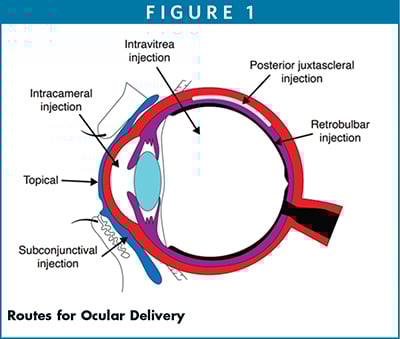 The typical route of drug administration in the eyes is topical (Figure 1). It is non-invasive and usually self-administrated. Challenges, particularly the immediate clearance of drugs by spillage and tear drainage that leads to reduced bioavailability, still exist.
Topical administration is preferred for two main reasons:
-
Only a limited amount of drug is permeated through the precorneal surface
-
Helps cross permeation of drugs through the cornea to aqueous by passive transcellular pathway.
It is, however limited by the membrane tight junctions that allow only 5% of drug absorption.5 So, solubility, molecular weight, ionic charges, lipophilicity, and pKa are all important properties that enable permeation, absorption, and bioavailability enhancement of drugs.
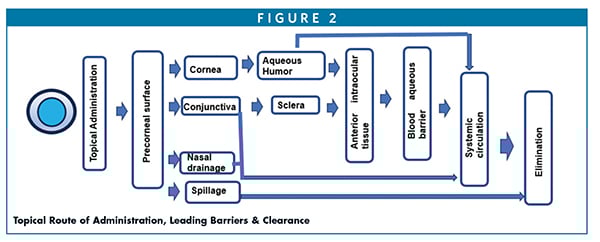 Figure 2 shows how the drug is distributed from the precorneal surface to the anterior segment through the cornea and conjunctiva/sclera pathways, several barrier layers, and eventually to systematic circulation and elimination. Drug distribution via nanoparticles through these barriers depends upon the molecular weight, lipophilicity, and ocular transporters, including proteins and melanin binding.6
Lipid Nanoparticles as Vehicles for Ocular Delivery
Saturated lipid nanoparticles (LNPs), nanostructured lipid carriers, liposomes, cubosomes, micro- and nano-emulsions, nanosuspensions, dendrimers, and micelles are all carriers for ocular or ophthalmic delivery. These assemblies ranging in size between 10 nm and 1000 nm are widely used to deliver a range of therapeutics to overcome the physiological barriers and to target specific ocular tissues.
They are derived from a range of pharmaceutically accepted and listed FDA inactive ingredients, including excipients, polymers, and co-solvents and surfactants. Thus, for designing appropriate safe and efficacious formulations by selecting one or more ingredients, the list of approved ingredients further facilitates the regulatory process.
Characterization of Nanoparticles
Nanoparticles for ocular delivery, like any other applications, require a thorough characterization that examines particle size uniformity, polydispersity, and homogeneity of the formulations. Visual appearance to identify insoluble particulates, transparency vs. translucency, or milky white are important critical quality attributes and must be optimized.7
Other important characteristics that should be monitored to maintain product quality are listed in the table below.

Dynamic light scattering (DLS) is typically used to characterize the particle size and polydispersity index (PDI) using a Malvern or Coulter counter analyzer. For ocular delivery, smaller PS and PDI particles are preferred to enhance the corneal permeation and bioavailability. Ocular formulations with low viscosity ranging between 2 mPas and 3 mPas allow better patient compliance; however, the higher viscosity allows for sustained release, less frequent dosing, and enhanced bioavailability.8
Surface tension of ocular formulations is critical for patient compliance and drug retention at the corneal surface. An ocular dose is typically 5-15 mL (with few exceptions) for commercial eye drops. Ocular formulations with surface tension of < 35 mN/m can lead to eye discomfort, but with surface tensions of 40-50 mN/m, they can provide more relief and comfort.9 Similarly, pH and osmolality ranging between 4 and 8 - and 231 and 446 mOsm/kg, respectively, can improve stability and lead to significant permeation of the drug through the eye.9
Nanoparticle technologies continue to address the challenges with poorly soluble molecules across all the dosages with the aim to increasing solubility and enhance bioavailability. Drug development teams must weigh options to identify and adapt new excipient technologies to bring the innovative drugs faster to market. That has driven the sense of urgency for finding technologies for unmet medical needs in ocular formulations. Consequently, several drugs have been approved employing nanoparticle technologies for the treatment of diseases affecting the anterior segment of the eye.
Nanoparticle technologies in ocular delivery have demonstrated wide utilities across small and large molecules. Several are already approved and many more molecules are undergoing clinical development. With the acceptance of nanotechnologies, we believe nanoparticle technologies will become vital in ocular delivery for the launch of new molecules to market with more innovative polymeric and lipid assemblies like cubosomes.10
Ascendia Pharmaceutical Solutions, with its enabling platform technologies – NanoSol® (nanosuspension), EmulSol® (nanoemulsion) and LipidSol® (lipid nanoparticles) – is primed to address the challenges of poorly soluble drugs. For example, our scientists can use EmulSol® to address the particle size with its top down/or bottom-up approach with FDA-approved excipients in nanoparticle formulations composed of 0.05% Cyclosporine A with a particle size <50 nm and composed of soybean oil, lecithin, and polysorbate 80.11 (superscript).
Supporting the nanotechnologies used during pre-formulation and formulation is our comprehensive cGMP sterile manufacturing capabilities. Ascendia Pharmaceutical Solutions is poised to tackle the challenges of formulation development and manufacturing of poorly soluble molecules to address the unmet medical needs to design better and smarter nanoparticle ocular formulations in the future.
Contact us today to learn how our Fast, Flexible, and First Time Right approach can meet your ocular drug development requirements.
References
- S. Li, L. Chen and Y. Fu, Nanotechnology-based ocular drug delivery systems: Recent advances and future prospects, J. Nanotechnology, 2023, 21, 232.
- I. Elsayed and S. Syed, Tailored nanostructured platforms for boosting transcorneal permeation: Box–Behnken statistical optimization, comprehensive in vitro, ex vivo and in vivo characterization, Nanomedicine 2017, 12, 7947-7962.
- C. R. Lynch, P. P. D. Kondiah, Y. E. Choonara, L. C. du Toit, N. Ally and V. Pillay, Hydrogel biomaterials for application in ocular drug delivery, Frontiers Bioeng. Biotech., 2020, 8, 228.7. S. Ahmed, M. M. Amin and S. Sayed, Ocular drug delivery: A comprehensive review, AAPS PharmSciTech, 2023, 24, 66.
- S. Gorantla, V. K. Rapalli, T. Waghule, P. P. Singh, S. K. Dubey, P. N. Saha, and G. Sanghavi, Nanocarriers for ocular drug delivery: current status and translational opportunity, RSC Adv. 2020, 10, 27835-27855.
- E. Sanchez-Lopez, M. Espina, S. Doktrovova, E. B. Souto and M. I. Garcia, Lipid nanoparticles (SLN, NLC): Overrcoming the anatomical and physiological barriers of the eye- Part I- Barriers and determining factors in ocular delivery, Eur. J. Pharm. Biopharm., 2017, 110, 70-75.
- A. E. Eldeeb, S. Salah and M. Ghorab, Formulation and evaluation of cubosomes drug delivery system for treatment of glaucoma: ex-vivo permeation and in-vivo pharmacodynamic study, J Drug Deliv Sci Technol. 2019, 52, 236–47.
- P. L. Destruel, N. Zeng, M. Maury, N. Mignet and V. Boudy, In vitro and in vivo evaluation of in situ gelling systems for sustained topical ophthalmic delivery: state of the art and beyond, Drug Discovery Today, 2017, 22, 638–651.
- N. Mehra, M. Aqil and Y. Sultana, A grafted copolymer-based nanomicelles for topical ocular delivery of everolimus: Formulation, characterization, ex-vivo permeation, in-vitro ocular toxicity, and stability study. Eur. J. Pharm. Sci., 2021, 159, 105735.
- Clinical Trials: https://classic.clinicaltrials.gov/ ct2/home.
- J. Huang, Compositions for nano-emulsion delivery systems, US Patent 10,251,837 (2019)