

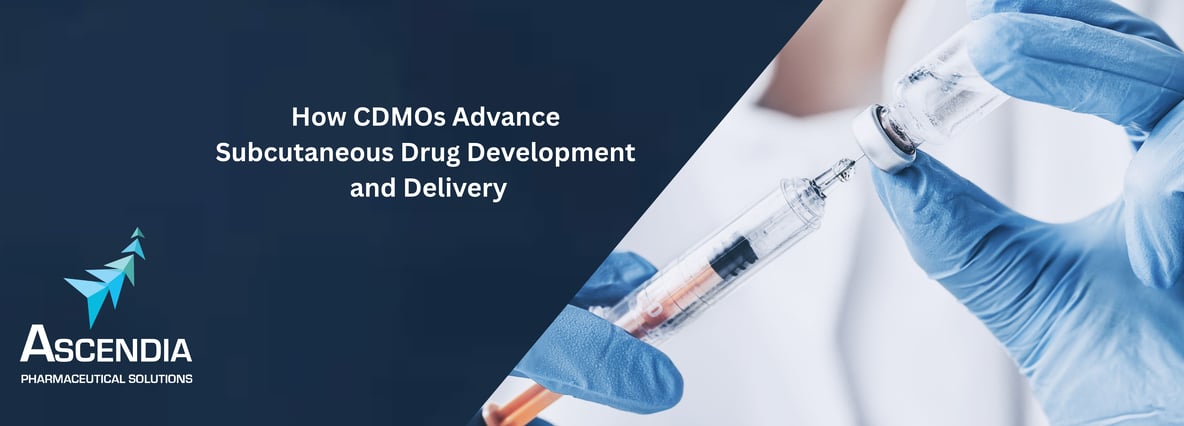
With continued interest in biologics addressing increasingly complex delivery conditions, drug development team faces a difficult balancing act. They must deliver an effective treatment dose while minimizing injection site reaction, such as skin irritation. High-concentration formulations are promising, particularly for subcutaneous (SubQ) administration, but often challenging due to high viscosity, aggregation, stability, and manufacturing.
To best address these issues, pharmaceutical and biological companies need to select a CDMO partner with expertise connecting molecular characterization with formulation design, aseptic or sterile processing, packaging, and the final delivery device.
For drug developers, Ascendia Pharmaceutical Solutions offers an integrated approach to these above challenges. Our experience with highly concentrated and viscous solutions and suspensions, including large molecules and biologics such as proteins and peptides, has helped us achieve a high success rate in advancing projects from formulation development into clinical manufacturing.
Turning High Concentration Complexity Into Opportunity
Biologic formulations at or above 100 mg/mL are typically considered high concentration, while concentrations of 250 mg/mL or more fall into the ultra-high-concentration range. These approaches can accommodate substantial doses in smaller injection volumes, supporting SubQ delivery for therapies targeting multiple conditions such as rheumatoid arthritis, psoriasis and neurological disorders.
Concentrating proteins can intensify protein–protein interactions, potentially increasing aggregation, particle formation and viscosity. These adaptations can compromise product quality, efficacy, long-term stability and safety, as well. A formulation that meets its concentration target must also remain manufacturable, compatible with its container and device, and capable of being administered at an acceptable injection force.
This is one reason why it’s important to select a CDMO with injection experience. Volume, viscosity, pH, and buffer strength can affect tolerability, while the intended prefilled syringe or autoinjector imposes practical limits on delivery. There is no universal formulation target as each molecule requires a customized dose, injection volume, stability and usability.
Steps to Make Formulation Decisions
Successful development begins with understanding the physical and chemical behavior of the molecule as concentration rises. Our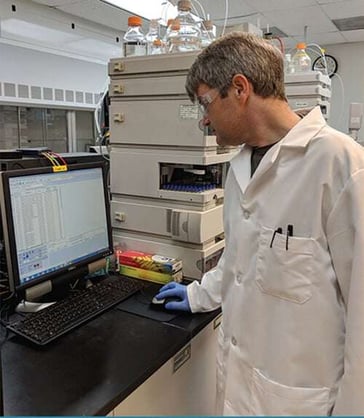 teams use differential scanning calorimetry to aid in assessing conformational stability, as well as dynamic and static light scattering to characterize particle size and colloidal behavior. Differential scanning fluorometry, circular dichroism, Fourier-transform infrared spectroscopy and nuclear magnetic resonance can provide complementary information about protein structure, as well.
Analytical methods must also detect chemical degradation and impurities. Liquid chromatography–mass spectrometry (LC-MS) can help identify and quantify degradants, including those associated with interactions between proteins and excipients. For example, some polysorbate-related degradation pathways can introduce reactive species that affect protein stability.
This characterization helps our team with excipient selection, pH and buffer optimization, processing conditions, and packaging decisions. By integrating formulation and analytical considerations early, we can reduce the risk of discovering incompatibilities or instability during scale-up. Our experience with challenging high-concentration formulations makes this development-oriented approach highly efficient, as it connects formulation decisions to downstream manufacturing requirements as long as the project stays on-schedule and within budget.
Thinking Beyond Conventional Aqueous Solutions
Viscosity reduction is one strategy to enable higher drug loading. Particle engineering, aseptic spray drying, and non-aqueous suspensions are designed to limit undesirable interactions or improve injectability. Carefully engineered particles can provide favorable flow characteristics and, for appropriate molecules, help address moisture-related degradation.
Research has been conducted on technologies using viscosity-modifying excipients, engineered microparticles and enzyme-enabled delivery to accommodate higher concentrations or larger injection volumes. These studies demonstrate that the formulation platform should follow the molecule’s properties and intended clinical use.
Spray drying is highly effective, as it generates fine powders for subsequent suspension in a suitable injectable vehicle. Other methods, including low-temperature solvent extraction and dehydration, may be relevant to thermally sensitive molecules. Any alternative vehicle, excipient or particle-based strategy, however requires careful evaluation of biocompatibility, stability, syringeability and regulatory suitability. Emerging ionic-liquid approaches are scientifically interesting, but evidence from oral-delivery studies should not be assumed to establish suitability for SubQ injection.
Manufacturing High-Concentration Injectables
A promising laboratory formulation is only the beginning. High-viscosity biologics can be difficult to mix, transfer, filter, and fill consistently. Equipment geometry, vessel size, mixing intensity, processing time, temperature, and pressure all influence performance. Excessive shear or prolonged processing may increase degradation risks, making thoughtful process design essential.
Sterile manufacturing adds another layer of complexity. Teams must consider environmental controls, aseptic technique, container compatibility, and filling equipment performance related to viscous products. These factors are especially important when transitioning from small development batches to clinical supplies.
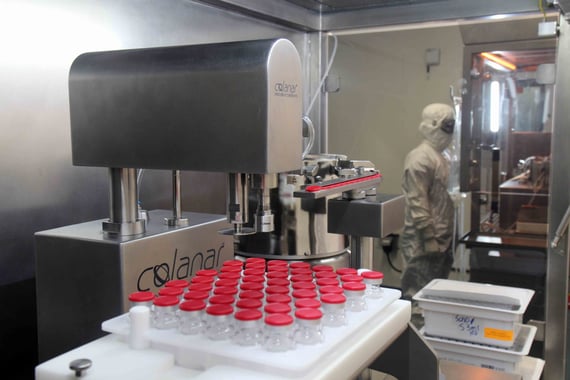 Ascendia brings relevant capabilities to this transition through our manufacturing and aseptic fill-finish operations for vials, prefilled syringes, and cartridges. Our New Jersey Bioscience Center facility includes ISO 5, ISO 6 and ISO 7 cleanroom environments, and its aseptic filling approaches can use peristaltic and piston pumps for high-concentration liquids. Aseptic spray drying is also part of our manufacturing capabilities for developing complex small- and large-molecule products. Together, these services help align formulation feasibility with the practical requirements of clinical-stage manufacturing.
There is an added benefit of having formulation development and manufacturing in the same location. Technology transfers are more efficient because the teams are in close proximity, creating a collaborative approach to ensure seamless advancement through each stage.
Selecting a CDMO Partner for Your Project
For high-concentration biologics, choosing a CDMO solely on filling capacity overlooks much of the development risk. An effective partner should understand the interplay among protein stability, viscosity, analytical methods, processing conditions, sterile manufacturing, and the intended delivery presentation.
Ascendia Pharmaceutical Solutions’ formulation expertise, experience with viscous solutions and nanocrystals or suspensions, specialized processing capabilities and multiple aseptic fill-finish formats make us a preferred and reliable CDMO partner for developing high-concentration injectable therapies. Our integrated approach built with capabilities can help teams evaluate formulation alternatives, anticipate scale-up challenges, and prepare drug products for clinical-stage supply without treating development and manufacturing as separate exercises.
As the demand for patient-friendly biologic delivery continues to rise, the success depends more on - achieving a high concentration, low volume, and less painful injectables. Formulations with preserved molecular integrity can be manufactured reproducibly and performed reliably at administration by our expertise embarks on fast, flexible and first-time right approach. A CDMO partner like Ascendia equipped to address those requirements across the development pathway can make a meaningful impact on advancing complex injectable medicines for unmet medical needs across all modalities.
To learn more about how Ascendia Pharmaceutical Solutions that that partner, contact us.
References
Drug Development & Delivery - High Concentration Biologics for Injectable Drug Delivery
Contract Pharma – High concentration large molecules for subcutaneous delivery