
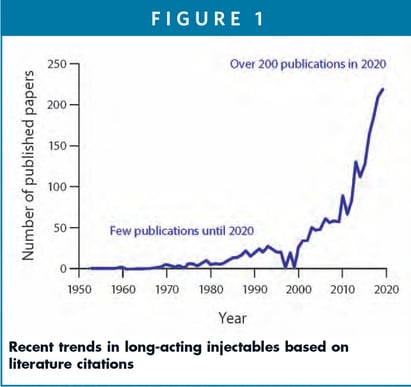
Long-acting injectables (LAIs), long-acting parenterals, long-acting depots, depot formulations, sustained-release parenterals, and controlled-release parenterals have experienced tremendous growth in the last 20 years (Figure 1).1 Nanoparticles(NPs), in particular, play a crucial role in extended-release of LAI formulations.
 Recently, there has been continued interest in parenteral NPs with sustained-release characteristics, as more new molecules being discovered are poorly soluble and less bioavailble.2 Successfully bringing LAI drugs to market requires experienced scientists, advanced formulation technologies, and state-of-the-art cGMP manufacturing capabilities. Ascendia Pharmaceutical Solutions checks all these boxes and meets all the attributes for a CDMO .
The significant growth in LAI drugs stems from innovative approaches that require:
-
Less-frequent administration to maintain longer and controlled release profile
-
Maintain high drug safety
-
Achieve high drug efficacy
The first bullet point makes LAIs more attractive from patient compliance perspectives as one dose can be released over several days, weeks and possibly months.3 As NP technologies continue to yield better and smarter formulations with longer release profiles, the industry is open to applying more innovative approaches to expedite the process for bringing new drugs to market.
LAI Platform Types
There are platform options available to drug development teams. The table below provides the pros and cons of each. Understanding the advantages and disadvantages helps select the best choice for certain drugs to advance in the clinical phases from early discovery.
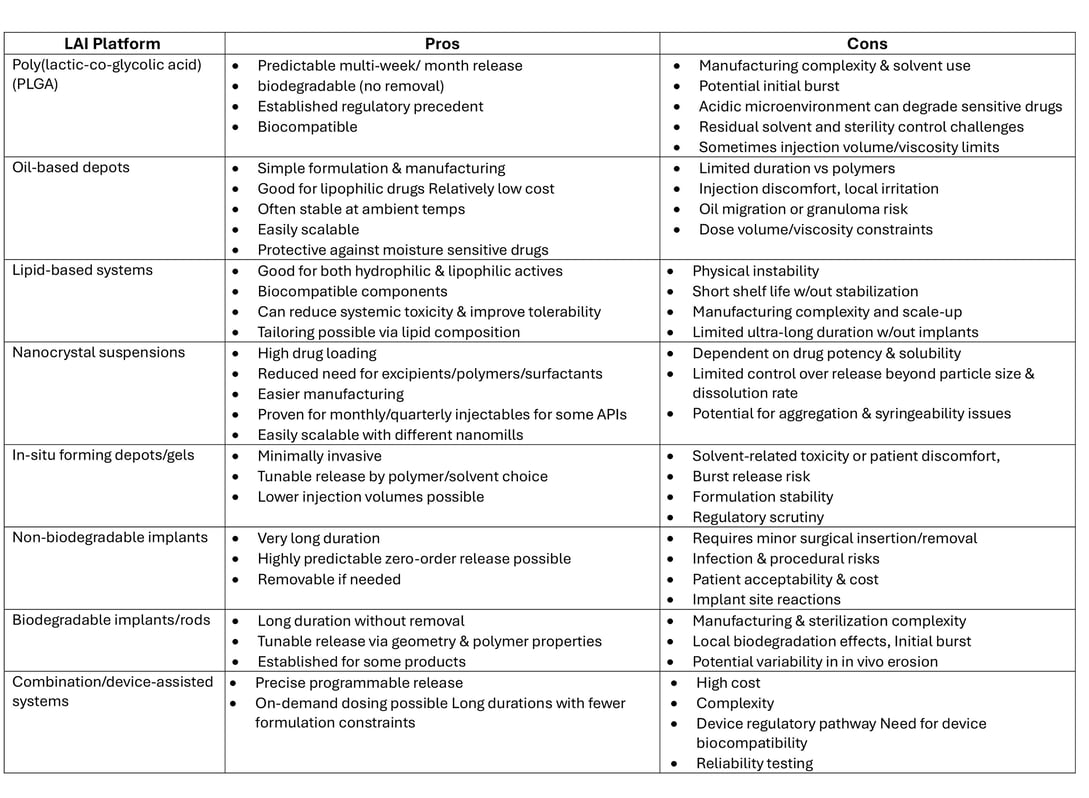
Regardless of the platform, there are tradeoffs that drug development teams need to consider when selecting which technology is best. Among the factors are duration vs invasiveness; drug properties; excipient choice, manufacturability and cost; and patient compliances.
Nanoparticles for LAIs
NPs are derived from polymers, lipids, surfactants/co-surfactants, and oils with unique identities based on the fatty acid characteristics and compositions, polar and non-polar headgroups, and hydrophilic and hydrophobic nature of polymeric chains. Particle size and dispersibility in aqueous solutions depends upon hydrophilic and lipophilic balance (HLB), molecular weight, and polydispersity. Encapsulation and drug loading characteristics depend on drug molecules and interstitial spaces within the polymeric or lipid assemblies. For these reasons, encapsulation, loading, stability, and efficient drug delivery are often key criteria when selecting the best technology for a particular project.
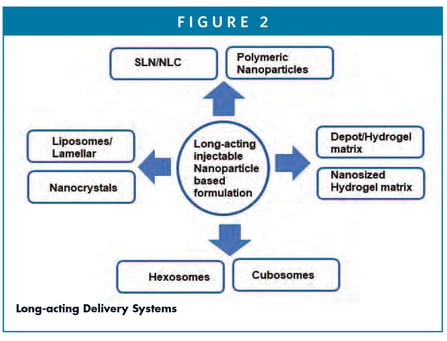
LAIs enable slow and controlled release, slower clearance rate, and resistance to enzymes with longer stability and extended half-life.4 Long-acting formulations fall into the following categories (figure 2):
- SLN/NLC
- Polymeric nanoparticles
- Nanocrystals/nanosuspensions
- Hydrogels
- Depots
- Lamellar assemblies (liposomes, cubosomes, hexosomes, et al)
- Long-acting microneedles and/or implants.
Finding the appropriate NP technology for a potential drug candidate depends on multiple factors, most notably the robust design, excipient selection and compatibility, efficient delivery, and long-term stability.
Key strategies include how to increase half-life and controlling drug release to maximize efficacy. Those tactics may include chemical modifications, PEG-ylation, lipidation, nucleic acid modification from in vivo clearance perspectives, microencapsulation, multi-vascular liposomes, oil-based assemblies, nanocrystals, hydrogels, microneedles, and implants as delivery systems.5
LAI Lipid-based Formulations
Lipid-based LAIs are oils, aqueous suspensions, and olegels. There are several oil-based LAIs approved in the market, eg, with castor oil (Faslodex®), cotton seed oil (Depo-Testosterone®), sesame oil (Haldol®), and cotton seed oil (Clopixol®). All are administered intramuscularly(IM).
LAI activities of these drugs stem from lipophilic fatty acid derived prodrugs that allow the cleavage of the parent molecule by hydrolysis of ester linkages. While the longer fatty acid slows the release of the drug due to higher partition barriers from oil phase to aqueous phase in an oil-based or suspension-based LAIs, it runs the risk for reducing potency of parent molecules.7 Lipophilicity and higher log P tend to slow release following IM injection, allowing the API uptake predominantly by lymphatic systems.6
Viscosity of injectable oils is one of a few other factors that may impact drug release. Sesame oil and organogels with higher viscosity and excellent tolerability by IM can slow release and create partitioning by diffusion mechanism from oil/gel into body fluid. Suspensions in oil of drug crystals is an alternative oil-based LAI. It is different from the suspensions in aqueous for injection. Oil-based suspensions have limited scope because they are hard to inject and may cause pain at the injection site. So, aqueous-based LAI suspensions are typically preferred.
Lipid-based liquid crystal forming systems are another alternative to LAI formulations. The liquid crystalline ability of lipids can provide a controlled-release mechanism by entrapping the drugs into the inner core of the fatty acid lipids. Hence, the sustained release is a result of slower diffusion of drug through the mesophase membrane. Plus, multiple polymeric and lipid-polymer hybrid nanoparticle LIAs have been tested in the preclinical substance use disorders (SUDs) by subcutaneous and intramuscular routes of administration for nicotine and cocaine vaccines.7
Nanocrystal Suspensions
There is strong interest in nanomilling to achieve the desired particle size for controlled drug release. The top-down and bottom-up approaches have been generally used to obtain the desired particles to achieve longer release profiles from injections. These approaches suffer with some challenges if the drug is poorly soluble, thus, making the risk factors higher if it requires higher doses. Therefore, efforts focused on liquid long-acting nanosuspensions with solubilizers and anti-flocculating processing aids for higher drug loading. The result is drugs are more patient-compliant and have improved the long-time safety profile.
Designing for Long Shelf Life
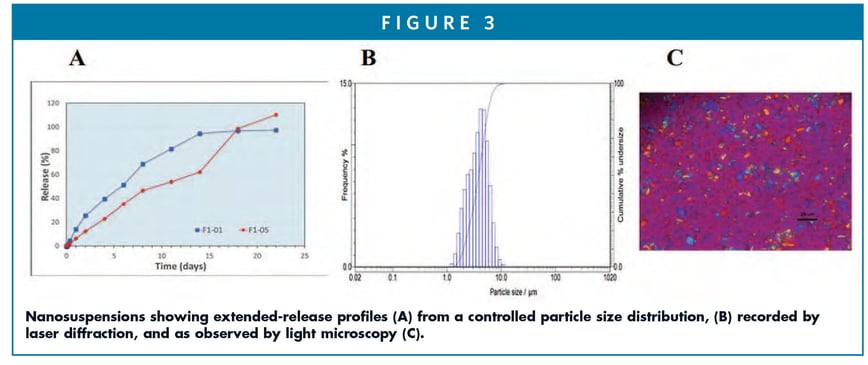
Drug preparation requires wet milling or high-pressure homogenization. The resulting LAI nanosuspensions can be lyophilized to improve the longer shelf-life. Drug release from nanosuspensions having the particle size distribution range of100-1000 nm as observed by light microscopy are shown in figure 3. The extended release of drug lasts for several days from the nanosized crystal suspensions.
Ascendia Pharmaceutical Solutions Advantage
As we continue to innovate new molecules, the industry is weighing all options and assessing nanoparticle technologies when developing drugs. Significant progress, however, has been made in LAIs to meet the clinical needs. More challenging molecules continue to be discovered to address the unmet medical needs for treatment of life-threatening aliments and for life cycle management. Dose variability and poor patient compliance pose safety risks, which warrant further assessments of nanoparticle technologies to formulate new LAI candidates for oncology, antivirals, central nervous system (CNS), and metabolic diseases among other modalities.
There is a continued paradigm shift in the design and development of nanoparticles for injectable drugs. All these challenges point to the fact that LAIs are very promising innovations with great potential to market, and life cycle management in general.
Ascendia Pharmaceutical Solutions is your Partner of Choice for LAI development projects for the following reasons:
- Capabilities in solubilization-enabling technologies to help with small and large molecules and biologics, and gene delivery.
- Nanotechnology expertise with our lipid-based LipidSol®, NanoSol®, and EmulSol® formulations. They are particularly well-suited for controlled release projects, as well as those with low solubility.
- cGMP manufacturing and lyophilization capabilities of injectable drugs. Our U.S.-based facility helps provide the tailor-made solutions to expedite development of lead candidates from early stage to late stage in the clinics and commercialization of drug products.
- Our state-of- the art Micro lab can further help expedite the testing of bacterial endotoxins and microbials in the LAI dosages
To learn how our Fast, Flexible, and First Time Right approach can help you with your LAI project, contact us.
REFERENCES
- L. Rahnfeld and P. Luciani, Injectable Lipid-Based Depot Formulations: Where Do We Stand?, Pharmaceutics, 2020, 12,0567.
- J. Huang and S. Ali, Long acting injectable nanoparticle formulations, Am. Pharm. Rev. (submitted, 2023).
- N. Kurnool and P. Tavari, Long acting injectables, J. Pharm. Sci., 2019, 11, 2857-2861.
- Al Qahtani, D. O’Connor, A. Domling, and S. K.Goda, Strategies for the production of long acting therapeutics and efficient drug delivery for cancer treatment, Biomed. Pharmacother., 2019, 113, 108750.
- Y. Shi, A. Lu, X. Wang, Z. Belhadj, J. Wang, and Q. Zhang, A review of existing strategies for designing long acting parenteral formulations: Focus on underlying mechanisms and future perspectives, Acta Pharma. Sinica B., 2021, 11, 2396-2415.
- R. W. Kalicharan, P. Schot, H. Vromans, Fundamental understanding of drug absorption from parenteral oil depot, Eur. J.Pharm. Sci., 2016, 83, 19-27.
- V. Kasina, R. J. Mownn, R. Bahal and G. C.,Sartor, Nanoparticle delivery systems for substance use disorder, Neuro psychopharmacology, 2022, 47, 1431-1439.