

Shaukat Ali, PhD, Jim Huang, PhD, Journal of Nanomedicine, September 2026
PEGylation — originally developed to shield proteins from immune recognition — has become the standard approach for giving lipid nanoparticles “stealth” behavior. The PEG corona creates steric repulsion that prevents particle aggregation, limits opsonization by plasma proteins, and slows macrophage clearance, which together extend systemic circulation and support tumor accumulation through the EPR effect. Six marketed products illustrate the breadth of the approach, from Doxil (1995) through Onivyde, Onpattro, Lipoplatin, and the Comirnaty and Spikevax mRNA vaccines. Roughly two-thirds of approved PEG-lipid products are oncology drugs, with over 200 clinical trials registered.
The review’s central theme is that PEGylation is a balancing act rather than a free benefit — the “PEG dilemma.” The same corona that prolongs circulation also suppresses cellular uptake and endosomal escape, and repeat dosing can provoke anti-PEG IgM, complement activation, CARPA-type hypersensitivity, and accelerated blood clearance. The FDA has called for anti-PEG antibody monitoring in new candidates.
Structurally, a PEG-lipid pairs a PEG-bearing hydrophilic headgroup with a saturated or unsaturated fatty acid tail, joined by a linker (often an ester, which allows enzymatic cleavage in circulation). Three design variables dominate performance:
- Terminal chemistry. Methoxy-terminated PEG gives the best stealth and bioavailability, but hydroxy-terminated PEG is markedly less immunogenic — one study reported over 90% less antibody binding and minimal complement activation versus mPEG. Butoxy PEG is more immunogenic than mPEG. Anionic charge on the headgroup drives complement activation and anaphylatoxin generation; methylating the phosphate oxygen suppresses it.
- Anchor chain length. Longer tails anchor more firmly. DSPE-PEG2000 (C18) has roughly a 24 h half-life on the particle, while DMG-PEG2000 (C14) sheds with a half-life near 1.3 h — and C14 desorption within 30 minutes is what enables efficient hepatocyte gene silencing. Measured desorption at one hour was under 1.5% for C16/C18 versus 45% for C14.
- Surface density and conformation. Low-density short chains adopt a mushroom conformation; high-density long chains form a protein-repelling brush. Raising DMPE-PEG2000 from 1 to 5 mol% shrank particles from 172 to 109 nm, raised PDI from 0.06 to 0.146, shifted zeta from −2.84 to −4.11 mV, and dropped mRNA encapsulation from 98% to 58%.
Efficacy data reinforce that less PEG often performs better in vivo. LNPs at 1.5% DMG-PEG2000 gave the most potent gene silencing in mice, with 5% and 10% requiring much higher doses; subretinal LNPs at 0.5% PEG produced a 19-fold luciferase increase over 5% PEG. Route and rate of administration also matter — bolus IV produced a slower immune response than slow infusion in rats, SC injection worsened ABC, and slow IV infusion in pigs raised complement activation and anaphylatoxins, which is why Doxil requires slow infusion.
The final section covers functionalized PEG lipids for active targeting: maleimide–thiol conjugation, DBCO/azide click chemistry, dual folate/Herceptin targeting reaching 75% transfection in SKBR3 cells, peptide-LNPs giving 4-fold tumor accumulation, EGFR-antibody LNPs doubling mRNA expression, and CD47-peptide LNPs achieving 5-fold higher blood retention. Polysorbate 80 is raised as a PEG-lipid alternative, showing 3–5-fold higher splenic mRNA expression than DMG-PEG2000 after IM injection. The authors close by positioning Ascendia’s LIPIDSOL platform — stealth liposomes, lipoplexes, and Poloxamer 407 cubosomes — for designing LNPs across small molecules and biologics.
Frequently Asked Questions
Q: What is a PEGylated lipid and what does it do in a lipid nanoparticle?
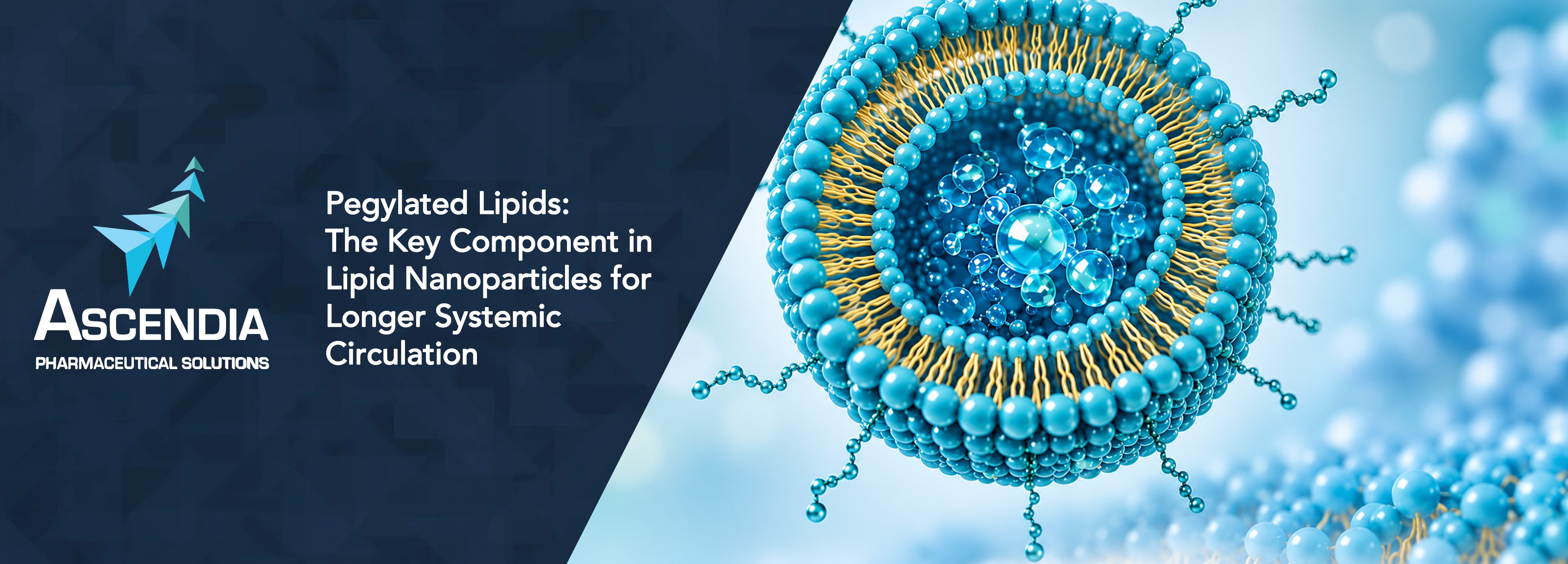
A PEGylated lipid is an excipient combining a hydrophilic PEG headgroup with a hydrophobic fatty acid tail, joined by a linker such as an ester. In an LNP, the fatty acid tail intercalates into the lipid bilayer while the PEG chain projects into the aqueous phase, forming a hydration shield or corona. This corona provides steric repulsion that prevents particle aggregation, reduces opsonization by blood proteins, and limits macrophage clearance — the “stealth” effect that extends systemic circulation.
Q: What is the PEG dilemma in lipid nanoparticle formulation?
The PEG dilemma is the trade-off that the same PEG corona which extends circulation also suppresses cellular uptake and endosomal escape, reducing delivery efficiency. Increasing PEG content improves stability and circulation time but can compromise transfection and drug release. Resolving it requires optimizing PEG amount, chain length, and anchor lipid rather than maximizing PEG density.
Q: Which approved drugs contain PEGylated lipids?
Six marketed products: Doxil (doxorubicin, 1995, HSPC:Chol:DSPE-PEG2000 56:39:5), Onivyde (irinotecan, 2015), Onpattro (patisiran, 2018, with PEG2000-C-DMG), Lipoplatin (cisplatin, 2018), Comirnaty (2021, with ALC-0159), and Spikevax (2021, with PEG2000-DMG). About 65% of approved PEG-lipid products are oncology drugs.
Q: What is the difference between DSPE-PEG2000 and DMG-PEG2000?
The difference is anchor chain length and how long the PEG lipid stays on the particle. DSPE-PEG2000 carries C18 chains and anchors firmly with a half-life of about 24 hours, favoring prolonged stealth circulation. DMG-PEG2000 carries C14 chains and desorbs with a half-life of about 1.3 hours, which promotes cellular uptake and hepatocyte gene silencing. After one hour in circulation, C16/C18 PEG lipids showed under 1.5% desorption versus 45% for C14.
Q: Why are hydroxy-terminated PEG lipids less immunogenic than methoxy-terminated PEG lipids?
OH-PEG lipids have lower affinity for anti-PEG antibodies than mPEG lipids. One study found hydroxy PEG-LNPs produced over 90% less antibody binding with minimal complement activation compared with mPEG LNPs. The trade-off is reduced stealth: mPEG terminals give the longest circulation and best systemic bioavailability. Butoxy PEG is more immunogenic than mPEG.
Q: What is the accelerated blood clearance (ABC) phenomenon with PEGylated LNPs?
ABC is the rapid clearance of a second dose caused by anti-PEG IgM generated after the first injection. Complement activation peaks 3–4 days after initial dosing. In rats, dosing above 5 µmol lipid/kg did not elevate anti-PEG IgM, while dosing below 1 µmol/kg considerably increased ABC. Subcutaneous injection increased the ABC effect relative to intravenous.
Q: How does PEG content affect LNP particle size and encapsulation efficiency?
Increasing PEG reduces particle size but can hurt payload loading. Raising DMPE-PEG2000 from 1 to 5 mol% reduced size from 172 nm to 109 nm, increased PDI from 0.06 to 0.146, shifted surface charge from −2.84 mV to −4.11 mV, and dropped mRNA encapsulation from 98% to 58%. With PEGylated cholesterol, encapsulation efficiency fell from 90% to 80% over the same 1–5% range.
Q: What is the optimal PEG lipid percentage in an LNP formulation?
Lower is generally better for in vivo potency, typically in the 0.5–1.5 mol% range. LNPs with 1.5% DMG-PEG2000 achieved the most potent gene silencing in mice, while 5% and 10% formulations required much higher doses. For subretinal delivery, 0.5% PEG gave a 19-fold increase in luciferase expression over 5% PEG. The optimum depends on route, target tissue, and anchor chain length.
Q: What is the difference between mushroom and brush PEG conformations?
The conformations describe how PEG chains arrange on the particle surface as a function of density and chain length. Low density with short chains gives a mushroom conformation; high density with longer chains gives an extended brush conformation. Brush conformation repels proteins more effectively and reduces protein adsorption, influencing circulation time.
Q: Why must Doxil be administered by slow infusion?
Slow infusion mitigates complement activation-related pseudoallergy (CARPA). In pigs, slow IV infusion of PEGylated LNPs raised complement activation and blood anaphylatoxin levels; bolus IV produced a slower immune response in rats. Slow, controlled administration is used clinically to manage these infusion reactions safely.
Q: How are PEG lipids functionalized for targeted delivery?
Through conjugation chemistries on the distal PEG terminus. Maleimide-PEG lipids couple to cysteine thiols on proteins and antibodies; DBCO or azide groups enable copper-free click chemistry. Reported results include dual folate/Herceptin targeting reaching 75% transfection in SKBR3 cells, peptide-LNPs at 0.3% conjugate giving 4-fold higher tumor accumulation and 2.6-fold higher transgene expression, EGFR-antibody LNPs doubling mRNA expression, and CD47-peptide LNPs (8.9 peptides per particle) giving 5-fold higher blood retention.
Q: Can Polysorbate 80 replace PEG lipids in LNPs?
Polysorbate 80 is a potential alternative because it has the same amphiphile architecture — oleic acid chains as the hydrophobic tail and polyethylene glycol as the hydrophilic headgroup. PS-80 LNPs showed 3–5-fold higher splenic mRNA expression than DMG-PEG2000 LNPs after intramuscular injection, and PS-80 LNPs carrying COVID-19 vaccine mRNA induced high anti-spike IgG titers from a single 5 µg IM dose.
Q: Why does FDA want anti-PEG antibody monitoring?
Because repeated dosing of PEGylated LNPs can induce anti-PEG antibodies that trigger complement activation, hypersensitivity reactions, and CARPA, and accelerated blood clearance — all of which reduce both safety and therapeutic efficacy. FDA has called for safety evaluation of long-circulating lipids, including monitoring anti-PEG antibody response for new drug candidates.