
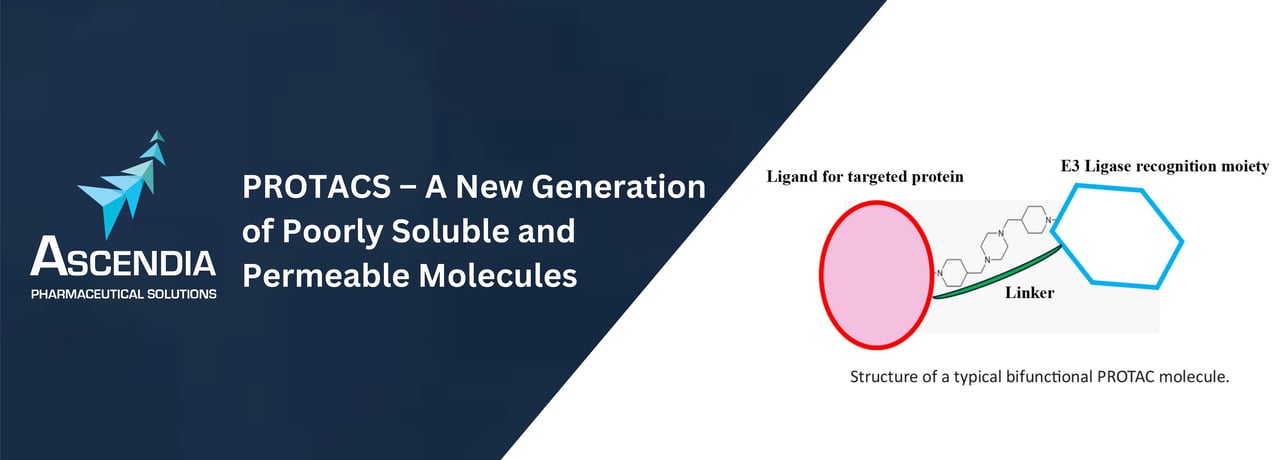
Proteolysis Targeting Chimeras (PROTACs) have recently gained considerable attention for their abilities to selectively target and degrade disease-causing proteins, and to overcome drug resistance.2 New approaches, such as Targeted Protein Degradation (TPD), represents a great opportunity in drug discovery to identify potential drug candidates. Ascendia Pharmaceutical Solution’s enabling platforms offer opportunities to leverage PROTACS, as well as small and large molecules, to develop a new generation of poorly soluble and permeable molecules that target proteins.
TPD aims at inducing proteolytic elimination of target proteins by programmed quality control machinery inside cells. It is involved in a range of ailments, including neurodegenerative disorders, immunotherapy, oncology, infectious dis-eases, multi-drug resistance diseases, among others.3
Delivery and Oral Bioavailability of PROTACS
As more molecules being discovered are poorly soluble, PROTACs remain the most challenging new generation of highly insoluble, impermeable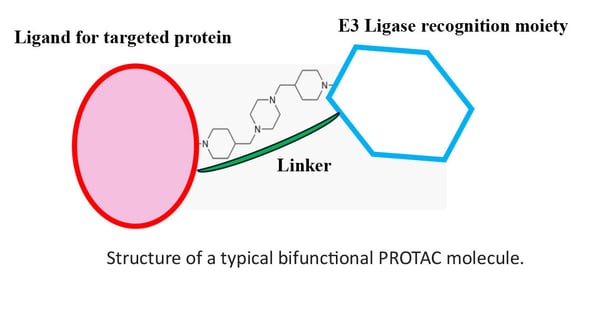 large molecules, qualified as beyond Lipinski’s Rule of Five (Ro5).4 Thus, finding the appropriate technologies for bringing these innovative molecules to clinic poses solubility and bioavailability challenges.
PROTACs are unique, complex and larger (MW > 800 Da) than traditional small molecules (MW < 500 Da). So, their permeation through membrane barriers is highly difficult, and often impossible. Those challenges offer an opportunity to explore the most innovative formulation strategies to enhance solubility, stability, permeability, and cellular uptake.
Two approaches have been used to overcome cell permeability challenges. First, structural optimization of PROTACs to boost the absorption and bioavailability, and second, use of advanced delivery systems for encapsulation, permeation, and efficient cellular uptake. Delivery vehicles include exosomes, liposomes, lipid nanoparticles, polymeric nanoparticles, amorphous solid dispersions, antibodies, and aptamers.5 Let’s discuss these in more detail.
Structural-based Delivery of PROTACS
Structural flexibility and rigidity of a PROTAC’s linker are critical for efficient complexing with Proteins of Interest (POIs) and E3 ligase on both ends of the molecule and enhancing the ubiquitination tagging and subsequent degradation of the POI by proteosome to peptide fragments.6 These structural modifications of a linker are essential for receptor recognition, cell permeability, and desired efficacy via intracellular internalization mechanism initiated through CD36 binding at the membrane outer surface. A fatty acid-based transporter, CD36, has been identified as a membrane receptor for PROTACs for their intracellular uptake.7
PROTAC’s ligases are based on a Cereblon (CRBN) or a Von Hippel-Lindau (VHL). In recent years, a few CRBN-based PROTACs have entered clinical trials.8 These investigational PROTAC molecules in clinical development target POIs like Androgen Receptor (AR), Estrogen Receptor (ER), Bruton’s Tyrosine Kinase (BTK), and interleukin-1 receptor-associated kinase 4 (IRAK4) associated with ailments like solid tumors, hematological malignancies, and autoimmune diseases.9
Nanoparticle-based Delivery of PROTAC
Drug delivery systems improve PROTAC’s solubility and increase exposure by prolonging systemic circulation while protecting it from enzymatic degradation. The particle size, drug loading, encapsulation efficiency, surface composition and charge, zeta potential, excipient compositions, and pH are factors that contribute to stability of nanoparticles. Nano-assemblies like polymeric micellar nanoparticles, mixed micelles, emulsions, nano-emulsions, liposomes, Solid Lipid Nanoparticles (SLNs), Nanostructured Lipid Carriers (NLCs), and exosomes are all important carriers for effective delivery of PROTACs.
Polymeric Nanoparticle-based Delivery Systems
Polymeric nanoparticles have been used in delivery of a range of therapeutics across all modalities. Self-assembled as aggregates in aqueous solutions, they act as solubilizers and stable carriers as micelles, nanospheres, nanogels, or drug conjugates for transporting drugs through membranes, yielding enhanced cellular uptake and bioavailability.10 Those carriers or excipients are amphiphilic in nature, meaning they possess both hydrophilic and lipophilic moieties in the same molecule.
Each PROTAC end is different – one is receptive to ER binding and the other is receptive to E3 ligase binding – helping to give promise in preclinical outcomes in polymeric nanoparticles.11 Nano-assemblies, such as polymeric micellar nanoparticles, mixed micelles, emulsions, nano-emulsions, liposomes, SLNs, NLCs, and exosomes are all important carriers for effective delivery of PROTACs.
Lipid Nanoparticles - Liposomes
Liposomes are comprised of inner hydrophilic and out hydrophobic regions where the drug’s molecules can be encapsulated, depending upon the drug structure. For large molecules like PROTACs, the hydrophilic moieties can reside in inner aqueous core, and the hydrophobic moieties can interact with the fatty acid within the bilayer. So, encapsulating PROTACs within the liposomes enhances stability and protects it from degradation by enzymes, thus minimizing the non-specific interactions with biological systems and reducing adverse effects.12
Self-emulsifying Drug Delivery Systems (SEDDS)
SEDDS have been used in formulation of BCS II and IV molecules and approved in several approved drugs.13 Studies suggest that a PROTAC is self-emulsified in an oil/surfactant-based emulsifying system. Comprised of oils, surfactants and cosurfactants, these assemblies can encapsulate and help protect PROTAC in the interior hydrophobic core by self-emulsifying in the aqueous solutions to tiny oil droplets (o/w micro/nano-emulsions), creating a larger surface area for enhancing the solubility and bioavailability of molecules. The compositions of the ingredients in SMEDDS/SNEDDS, including oils, surfactants and co-surfactants, are critical to produce smaller particles with large surface area to enhance stability and oral bioavailability by protecting in gastrointestinal tract.14
Solid Dispersion-based Delivery Systems
Amorphous Solid Dispersions (ASD) remain the most versatile technology for improving the solubility and oral bioavailability of challenging molecules stemming from high melting and high logP.15 Requiring a compatible polymer with a drug in organic solvent(s), ASD can be scaled up on a range of commercial spry dryers. Several drugs have been approved as ASDs.16
In spite of a widely used SD technology, not all molecules are compatible due to their inherent higher crystallinity and melting, and poor solubility. Therefore, technologies other than ASD have also been used. Polymers like Soluplus®, Copovidone, HPMCAS, Povidone, Polyvinyl alcohol, Poloxamers, Eudragit, and high molecular polyethylene glycols are used as polymeric carriers. With the invention of bR05 molecules like PROTACs in recent years, some polymers have also been used in solid dispersions to increase solubility, permeability and bioavailability of those molecules.
Ascendia Pharmaceutical Solutions has the Answers
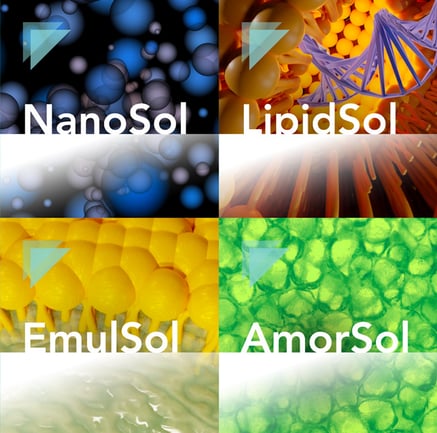 Ascendia Pharmaceutical Solution’s enabling platforms offer opportunities to tackle not only the small and large molecules but also PROTACS.
- AmorSol®, an amorphous-based technology, can help design smarter and better formulation for ASDs yielding the desired outcomes for enhancing oral bioavailability.
- Likewise, for oral liquids, EmulSol® technology might be extended to formulate and deliver the appropriate solution in SEDDS/SNEDDS, yielding enhanced oral bioavailability by selection of Generally Accepted as Safe (GRAS) excipients, polymers and solubilizers.
- LipidSol®, for its unique lipid assemblies, LNPs and liposomes can be extended for lipophilic PROTACs bearing hydrophilic and hydrophobic entities.
PROTACs co-delivered with chemotherapeutic agents underscore the importance of combination therapy for drug resistance cancers by accelerating synergistic anti-tumor effects while reducing drug toxicity. With its previous experiences with PROTACs coupled with the expertise in enabling technologies and U.S.-based state-of-the-art cGMP aseptic and non-aseptic ISO cleanrooms, Ascendia Pharmaceutical Solutions can help expedite the formulations undergoing early and late phases of clinical development.
Contact us to learn how our technologies and scientists can address your drug development projects.
References
- Syahputra EW, Lee H, Cho H, Park HJ, Park KS, Hwang D. PROTAC delivery strategies for overcoming physicochemical properties and physiological barriers in targeted protein degradation. Pharmaceutics. 2025; 17: 501.
- Sincere NI, Anand AK, Ashique S, Yang J, You C. PROTACs: Emerg-ing targeted protein degradation approaches for advanced druggable strategies. Molecules. 2023; 28: 4014. doi:10.3390/molecules28104014.
- Morgenthaler J, Rische M. Drug delivery – recent trends, enabling technologies, in-vitro-in-vivo predictions and personalized medicine. Drug Dev Deliv. 2025 Sep.
- Edmondson SD, Yang B, Fallan C. Proteolysis targeting chimeras (PROTACs) in beyond rule-of-five chemical space: Recent progress and future challenges. Bioorg Med Chem Lett. 2019; 29: 1555–1564.
- Fan G, Chen S, Zhang Q, Yu N, Shen Z, Liu Z, et al. Proteolysis-targeting chimera (PROTAC): Current applications and future directions. MedComm. 2025; 6: e70401.
- Abeje YE, Wieske LHE, Poongavanam V, Maassen S, Atilaw Y, Cromm P, et al. Impact of linker composition on VHL PROTAC cell permeability. J Med Chem. 2025; 68: 638–657.
- Wang Z, Pan BS, Manne RK, et al. CD36-mediated endocytosis of proteolysis-targeting chimeras. Cell. 2025; 188: 3219–3237.
- Apprato G, Poongavanam V, Jimenez DG, Atilaw Y, Erdelyi M, Er-mondi G, et al. Exploring the chemical space of orally bioavailable PROTACs. Drug Discov Today. 2024; 29: 103917.
- PROTACs clinical trials [Internet]. Available from: https://www. biochempeg.com/article/434.html
- Yang K, Yu G, Yang GZ, Yue ZL, Zhang X, Sun C, et al. Supramolecular polymerization-induced nano-assemblies for self-augmented cascade chemotherapy and chemodynamic therapy of tumor. Angew Chem Int Ed. 2021; 60: 17570–17578.
- Wu X, Shu Y, Zheng Y, Zhang P, Cong H, Zou Y, et al. Recent advances in nanomedicine: Nano-PROTAC delivery systems for cancer therapy. Pharmaceutics. 2025; 17: 1037.
- Chen Y, Tandon I, Heelan W, et al. Proteolysis-targeting chimera delivery systems: Advancing protein degraders towards clinical translation. Chem Soc Rev. 2022; 51: 5330–5350.
- Ali S, Kolter K. Challenges and opportunities in oral formulation development. Am Pharm Rev. 2012 Dec.
- Buya AB, Beloqui A, Memvanga PB, Préat V. Self-nanoemulsifying drug-delivery systems in oral drug delivery. Pharmaceutics. 2020; 12: 1194.
- Ali S, Kolter K. Tackling the challenges with poorly soluble drugs. J Anal Pharm Res. 2015; 1: 1–3.
- Moseson DE, Tran TB, Karunakaran B, Ambardekar R, Hiew TN. Trends in amorphous solid dispersion drug products approved by the FDA. Int J Pharm X. 2024; 7: 100259.